Vestigo Partners works with entrepreneurs, investors, and policymakers to navigate emerging issues presented by globalization and disruptive technologies.
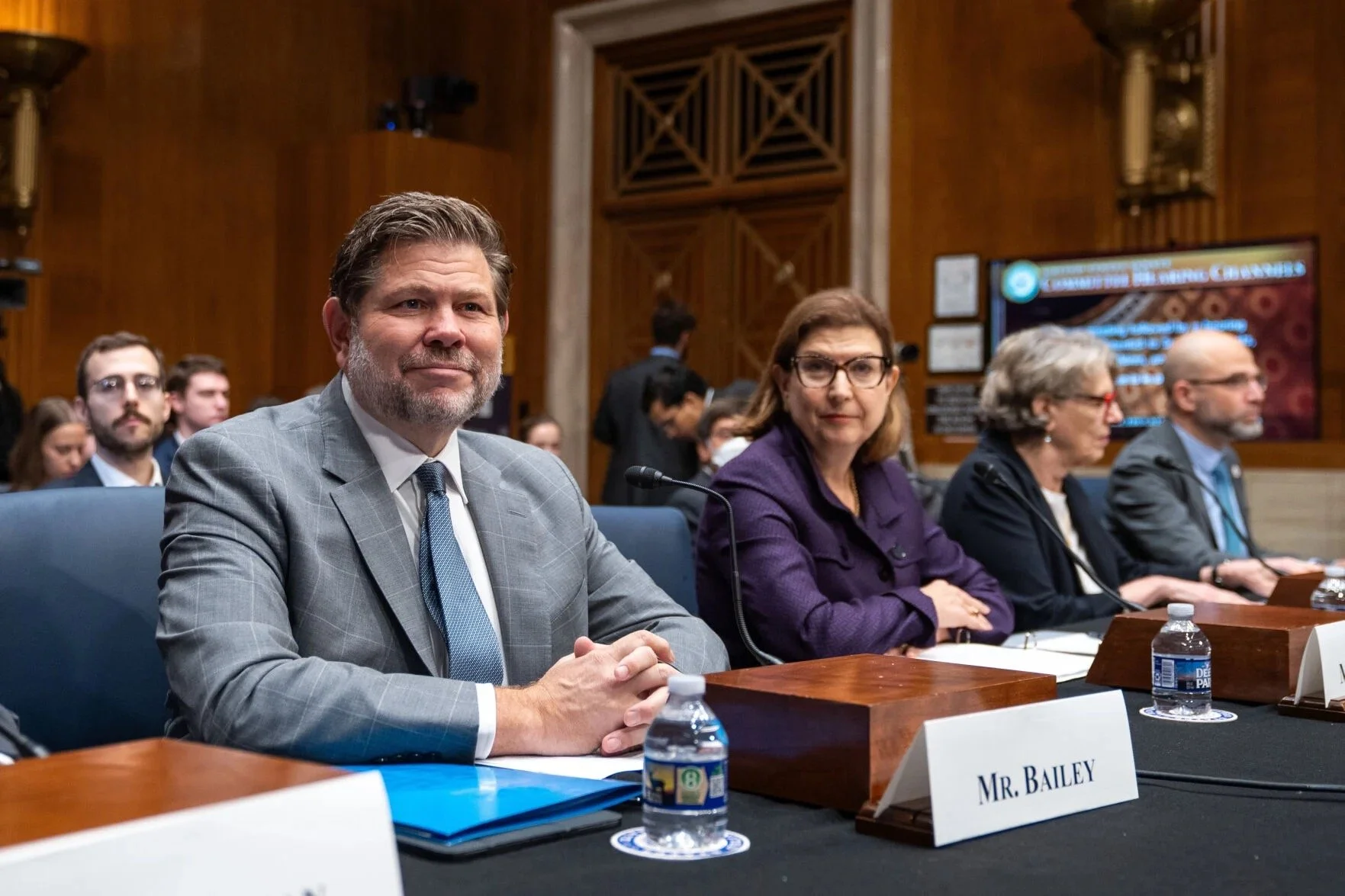
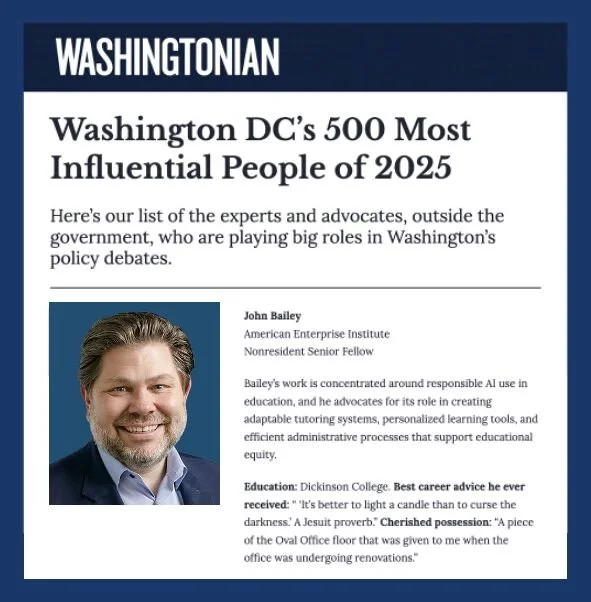
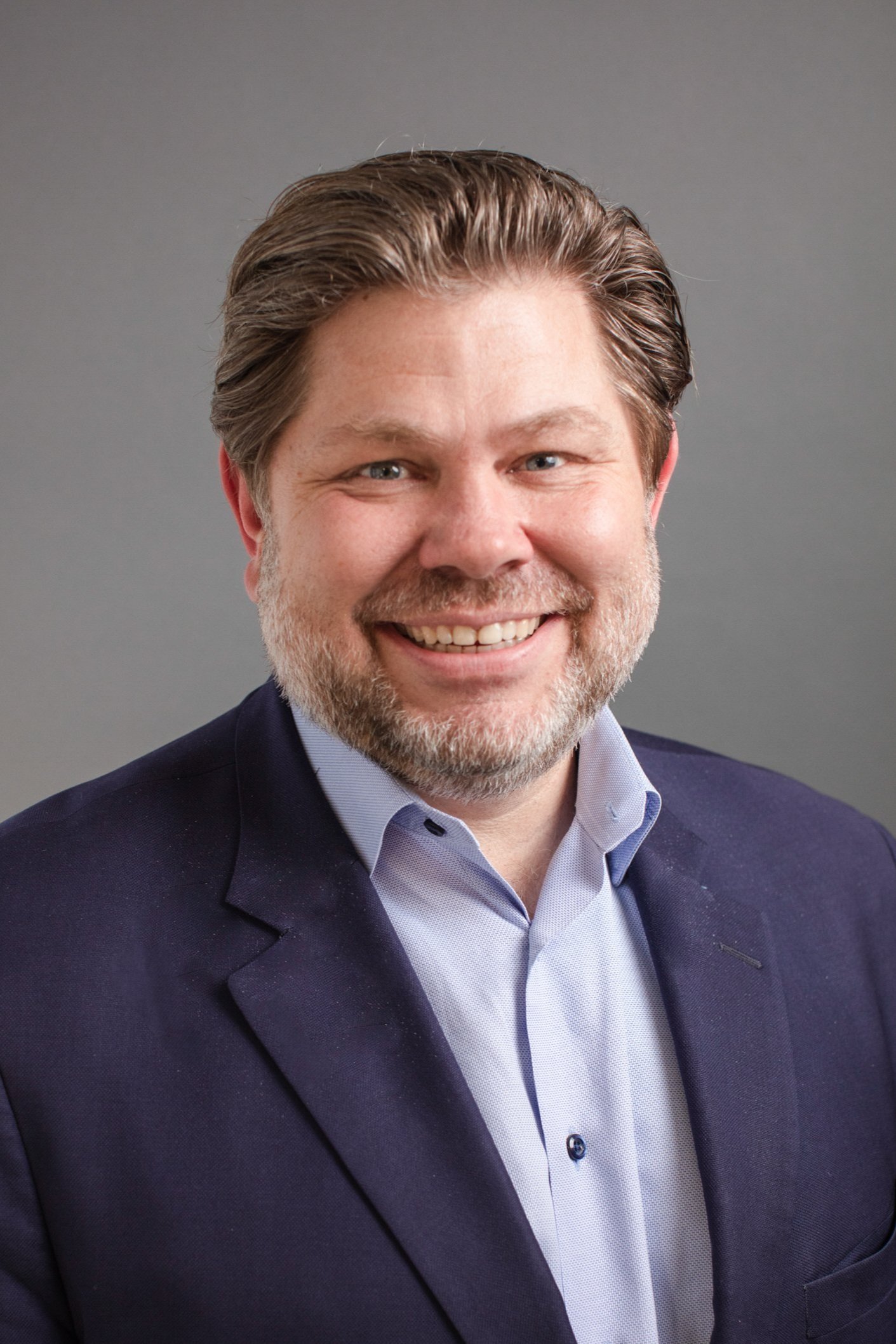
John Bailey
John’s experience has spanned government, philanthropy, and the private sector working on a range of issues including technology, immigration, education, and economic mobility.
He current serves as a fellow at the Chan Zuckerberg Initiative, and as an advisor to the Walton Family Foundation. He is also a visiting Fellow at the American Enterprise Institute working on COVID-19 and Opportunity Zones. And he is a Sammons Enterprises Fellow at the George W. Bush Institute.
John previously served as a domestic policy advisor in the White House, Deputy Policy Director to the U.S. Secretary of Commerce, and Director of Educational Technology at the U.S. Department of Education. He co-founded the strategic advisory firm Whiteboard Advisors, served as a senior program officer at the Bill and Melinda Gates Foundation, and most recently was the VP of Policy for Governor Jeb Bush’s Foundation for Excellence in Education.
John is on the board of directors for Zearn Math. He also serves on advisory boards for Pope Francis’ Scholas Occurrentes, the Aspen Institute’s Future of Work, the Tech Talent Project, the Center for Democracy and Technology, National Alliance for Public Charter Schools, Hypothesis Studio, and Kenzie Academy. He is a Pahara-Aspen Institute Fellow and a member of the Aspen Global Leadership Network.
He has served as a reviewer for the Communities Thrive Challenge, Adult Literacy XPrize, the $1 Billion Wage Gain Challenge, and Fannie Mae’s Sustainable Communities Innovation Challenge.
John has served on the DC board for the social innovation fund Indego Africa and the Data Quality Campaign. He co-chaired the Aspen Institute’s Task Force on Connected Learning and was an ex-officio member of the U.S. Department of Education’s Higher Education Commission. He is also an alumnus of the American Council on Germany Young Leaders Program.
Featured Writing
I’m honored to have been appointed as the Sammons Enterprises Fellow at the Bush Institute. I will be focusing on education and workforce issues, including supporting several of the Institute’s initiatives. It’s an exciting opportunity and I’m flattered to have been selected along with Keith Hennessey , Nicole Bibbins Sedaca, and Robert A. McDonald.
An essay I wrote for EducationNext describing how we can approach safely reopen schools. I cover what the most recent scientific studies tell us about risks for children as well as if they are super spreaders of COVID-19. Other issues include how to address SEL, academic learning loss, and improving distance learning to provide a better experience for both teachers and students next year.
Recent media coverage in Axios, USA Today, Time, Politico, Christian Science Monitor, The 74, and the Baltimore Sun.
An analysis of data from the 4,000 parents surveyed over weeks that gives us a better sense of how parents are navigating the challenges of COVID-19, what they expect with reopened schools, what they want after the killing of George Floyd, and how they are uses their CARES Act direct cash benefit. All of the data is also available on AEI’s website.
On Sunday, the NYT Editorial Board published an editorial mentioning our research on the number of teachers who may be vulnerable to COVID-19. “An analysis by John Bailey of the American Enterprise Institute shows that 18 percent of teachers and 27 percent of principals fall into the high-risk age category. Districts might end up offering buyouts for some their most vulnerable employees — and finding roles outside of schools for the others. This could create a staff shortage at precisely the time when districts are trying to lower the risk of spreading infection by cutting class size and staggering schedules to limit population density in school buildings.”
Everyone was taken by surprise when schools closed their doors to over 55 million students this spring. When schools reopen, there will be important accommodations to protect students and staff. But some teachers and school personnel — as many as half a million — may not be able to return to school building due to being more at risk for contracting COVID-19. Schools need to adequately prepare for what can only be described as a mounting school personnel crisis in the fall.
A distinguished group of 21 former federal government officials (spanning the Clinton, Bush, and Obama administrations), state school chiefs, charter school leaders, and superintendents have provided of the important considerations needed to open schools in the fall.
To slow the spread of Covid-19, governors in 46 states have closed more than 91,000 U.S. public and private schools, affecting more than 50 million school students. Governors now confront the difficult questions of whether to reopen schools, and if so, when?
A number of strategies can be deployed to flatten the curve: washing hands, canceling mass gatherings, working from home, self-quarantining, avoiding crowds — and closing schools. No one single action is enough. They must be combined to provide a comprehensive approach to slow the spread. This article explores the role of school closures in flattening the curve.
In 2005, while serving as deputy policy director at the U.S. Department of Commerce, I served on an interagency team led by the White House Homeland Security Council that developed the National Strategy for Pandemic Influenza and National Strategy for Pandemic Influenza Implementation Plan. The strategy relied heavily on ways of slowing the spread of viral transmissions – “flattening the curve” – to reduce strain on the healthcare system and provide the time needed to develop and deploy vaccines. One such measure is closing schools.
The federal Opportunity Zone program offers the chance to invest in entrepreneurs in overlooked communities. A central animating theme of the American dream is that anyone with an idea can launch their own business. This entrepreneurial energy makes enormous contributions to society by addressing unmet needs, improving lives and solving pressing problems. These entrepreneurs also serve as an economic engine for communities by creating jobs that lift people out of poverty.
I had the privilege of participating in the event where Pope Francis inaugurated the new headquarters in Vatican City of Scholas Occurrentes. The event was also used to serve as a ceremonious launch for the U.S. chapter based in Los Angeles. I’m honored to be part of the advisory board and look forward to the important discussions that will emerge from this work.
Pictures from a recent trip to South Africa visiting andBeyond’s Phinda Lodge, Londolozi, and Jabulani. Incredible experience learning about important conservation efforts to protect species, including elephants and rhinos. And a very powerful experience visiting the Apartheid Museum and several places that played important roles in Nelson Mandela’s journey.
The Opportunity Zones program is the largest community-development initiative in a generation, but its success isn’t guaranteed. Policymakers, mayors, community leaders, investors, developers, and philanthropic organizations will have to work together to get the best results for Opportunity Zone residents. If education leaders pursue these investment opportunities, they, too, can benefit from the program—and ensure better outcomes for those in distressed communities for generations to come.
The evolving nature of work requires that we also evolve our system of training individuals for the jobs of today and tomorrow, and rethink the way we provide financial support. Income Share Agreements are a compelling financial innovation offering a solution for the students these new models serve.